
I Caught It Before the Fall
On burnout, presence, and the art of doing nothing

It was one of those slow afternoons that asks nothing of you.
I had picked Lilly up from her playgroup one day last week while Lua napped at home with Christian. Just the two of us. Since her sister was born, there is a need in Lilly that she cannot quite name yet — she doesn’t have the words for it, but I feel it every time. Time with mama. So I took her to our favorite tea house with the little play area in the corner, ordered my tea, and watched her immediately set about hosting an imaginary tea party for every stuffed animal in the place.
I sat back on the sofa. Sunlight was coming through the windows in long warm streaks. Lilly was murmuring to a stuffed rabbit. I lifted my cup.
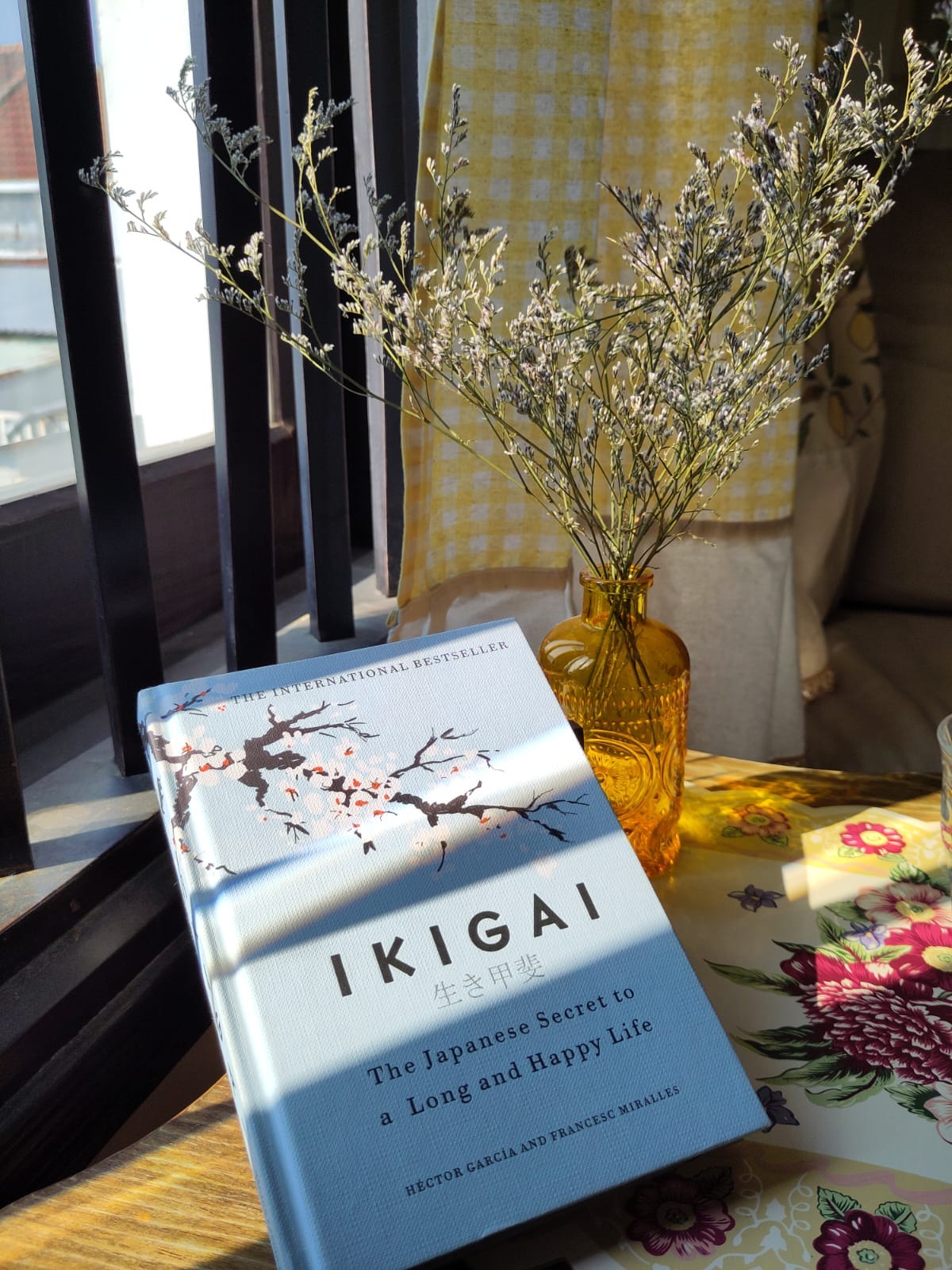
We had been to this tea house before. Several times, in fact. But that afternoon — perhaps because I was finally, actually present — I noticed something I had never seen before. A single book, leaning by itself against the far bookshelf. Not shelved with the others. Just... leaning there. Waiting.
Ikigai: The Japanese Secret to a Long and Happy Life.
I had heard of it. Seen it mentioned. Never opened it. I set down my tea and reached for it.
A few pages in, I found this:
“Stress has a degenerative effect over time. A sustained state of emergency affects the neurons associated with memory, as well as inhibiting the release of certain hormones, the absence of which can cause depression. Its secondary effects include irritability, insomnia, anxiety, and high blood pressure.”
I stopped.
I have been feeling most of the effects that was listed, for quite some time. The goosebumps came first — shooting through my body before my mind had even caught up. Not a thought. A recognition. Something in me that already knew, finally being spoken aloud.
Oh. This is what it is.
It felt like someone had gently removed a blindfold I hadn’t known I was wearing. An overwhelming feeling of relief landed.
The memory of my corporate burnout flooded back. Basel, 2016. The crying I couldn’t explain. The counsellor who said, softly, yes, but not usually this sad. The sabbatical. South America. The long way back.
I had been here before.
And here is where the shame arrived — quietly, but unmistakably. Because I am someone who writes about flow. About awareness. About listening to the body before it shouts. I preach this. I believe it. And yet I had walked — slowly, steadily, without noticing — right back to the edge.
How could I have let this happen again?
I want to sit with that question honestly, because I think many of you will recognize it. The particular sting of falling short of your own ideals. Of knowing better and still arriving here. It doesn’t feel like failure exactly. It feels like disappointment — in yourself, by yourself, for yourself. A quiet sense of having let the people who trust your words down too.
But then I thought about the blindfold. And how you cannot remove what you cannot see.
Looking back now, I can trace the shape of it.
For at least a year — probably longer — one thought has lived rent-free in my chest, never fully leaving, even in sleep: the money.
Christian and I made this decision together, with full hearts. He holds the fort — the meals, the girls, the ten thousand small things that hold a family upright — while I build the income stream for all four of us. I am so grateful for him. Genuinely. Without him, the weight would be unbearable.
And still. The weight is real.
I would sometimes open our banking app and watch the number go down, and my heart would skip a beat — every single time. Like a ticking clock. I have been gripping the handrail of this moving train for so long, white-knuckled, trying to accelerate it through sheer force of will, that I forgot entirely to stop and rest between the stations.
When we were in Pai, Thailand, I had a rhythm. Every weekday morning I would go to the Journey Into Oneself space — the serene, sunlit practice space that Shifu Zuan and the JIO team had built — and move through my Taiji QiGong. That daily practice was my anchor. It was the thing that put me back inside my body when my mind was running too fast.
When we arrived in Vietnam, I lost it. I don’t know exactly why. The rhythm simply didn’t rebuild itself. And I didn’t fight to find it either. Weekdays and weekends blurred. I wasn’t working long hours the way I once did in my corporate life, or during the years when I was building Impact Hub Basel alongside a full-time job. But I was working a little, every day. And I was thinking about the money situation every day. Constantly. For months.
That is the thing about consistent, minimal-on-the-surface pressure. It doesn’t arrive like a wave. It accumulates. Slowly. Until one day you notice you are soaking wet and can’t remember how long ago it started.
Forgetting a meeting. Putting the wrong toothpaste on Lilly’s brush. The fog that settled over my thinking like gauze. These were not random moments of scatteredness. They were signals.
My body was already speaking. I simply wasn’t in the room to hear it.
And when the signals finally broke through, they came as sadness.
Without reasons that make sense to me. Just a heaviness that would arrive without warning — pressing down on my chest, heavy. Some afternoons this week I have simply had to lie down. Curl up. Let it move through me.
The tears would come too, catching me off guard. Christian, without needing to be asked, would quietly take the girls away. But sometimes they were already there. And Lua — two years old, so earnest, so present — would notice and come close. She would see the tears on my face and ask in that small, serious voice of hers: What happened, mama?
And I would look at her, and give her a kiss, and say: I don’t know. Mama feels a bit sad.
She would look at me for a moment. Then: Aww. It’s ok, mama. And she would kiss me back.
I am not too proud to say that my two-year-old’s compassion undid me a little further. In the best possible way.
The girls are my anchor right now. Because of them, I know I will come through this. I want to be a stronger mama on the other side — and that wanting is enough to keep me moving, even on the days when moving means nothing more than getting up and making the tea.
It’s not all sadness. Some days are good. Some not so. It ebbs and it flows.
I am on the path to burnout. I know this now. And the grace — the thing I am genuinely grateful for — is that I caught it before the fall.
And then last week, my body stopped waiting for my permission and took matters into its own hands.
The illness arrived and forced me horizontal. Pain that asked nothing of me except to stop. At the time, I resented it — the timing, the inconvenience, the days lost. But sitting in that tea house with the goosebumps still on my arms, I understood it differently.
It wasn’t an interruption.
It was an intervention.
Thank you, I thought. To whatever it was — the universe, my own nervous system, the angels or guides who seem to arrange these small, significant collisions with the right book at the right moment. I finally heard you. I am here.
Around this time, I had also come across something from my friend Tamara. She wrote recently about finally getting her first tattoo after a decade of hesitation — and the central insight of her piece landed squarely in my chest: that sometimes we have thought about something long enough. That more time to think is not what we need. What we need is to stop grasping at the idea of the perfect moment and simply move.
I had been doing the opposite of that with rest. I kept telling myself I would slow down after — after this project, after this milestone, after I had figured out the financial piece. After, after, after.
I was reading her piece on my phone, scrolling. And that’s when I noticed the other thing.
I had been on my phone more than usual during the illness. Scrolling not out of genuine curiosity but out of habit. Out of a kind of low-level anxiety that had learned to disguise itself as information-seeking. I'd reach for it without deciding to. I'd set it down and pick it up again within minutes. That pull — restless, compulsive and the kind you notice mid-reach and feel a little embarrassed about — was its own kind of signal. Tamara had deleted Instagram from her phone entirely as an experiment for a month. I read that and felt something loosen in my chest. Yes. That.
The phone was not helping me rest. It was keeping me in the emergency frequency, just at a lower volume.
I remembered then what my Shifu had taught me.
无为. Wu Wei.
Effortless action. Doing without doing. Wanting without grasping.
From the Nei-yeh, the ancient Taoist inward training text:
“When your body is not aligned, the inner power will not come.
When you are not tranquil within, your mind will not be well ordered.
Align your body, assist the inner power, then it will gradually come on its own.”
Gradually. On its own.
Not forced. Not optimized. Not accelerated through willpower and ambition and a white-knuckled grip on the outcome.
I had known this teaching for years. I had shared it. Written about it. And somewhere along the way I had quietly shelved it — the way you shelve the books you love most, confident they’ll be there when you need them, and then forget to reach for them in the moments you actually do.
During one of Shifu Zuan’s talks after morning practice, he spoke about drinking tea.
He said that the Buddha taught not to live in extremes — not in total stillness, not in constant striving — but in the flow between the two. Not a rigid middle way. Just the way that is balanced. Natural. Responsive to what is.
He also said: don’t make a spiritual handbag out of your practice. Don’t clutch it so tightly it becomes another form of grasping. If you miss a practice, it is okay. Come back when it feels right. And drink tea — not as a ritual, not as a prescription, but as a reminder to return to yourself.
I had been drinking tea that afternoon with Lilly when I found the book.
I had already been doing Wu Wei before I remembered its name.
The girls regulate me as much as I regulate them. That afternoon, Lilly’s quiet imaginary world had slowed my breathing, softened my shoulders, brought me back to the room. The sunshine. The stuffed rabbit. The cup warming my hands. I was present enough to notice a single book leaning out from a shelf I had walked passed a dozen times before.
Presence revealed what busyness had always hidden.
So. What now?
I know what I want to do, and I also know that the moment I make it a list — practice Taiji, step away from the phone, write in my journal, spend time as a family — I have turned rest into another project. Another thing to perform. Another standard to meet and then feel guilty about missing.
So instead, let me say this simply:
I am going to take a couple of weeks away from writing and from this space. Maybe a little more, maybe a little less — I want to hold it loosely. What I know is that I will be closing the laptop. Stepping away from the scheduled rhythm. Giving myself permission to not produce anything for a while.
Not to fill the time with a different kind of doing.
Just to stop. To let clarity arise the way Shifu said the inner power does — gradually, on its own, when the body is finally aligned and the mind is finally quiet.
I will come back. Writing and creating these letters genuinely lights me up — it is one of the things that recharges me, not one of the things that drains me. To those of you who support this work financially, thank you from the bottom of my heart. Your generosity is something I hold with real care, and I will not be gone long.
But right now, my body has asked me to stop grasping.
For real, this time.
Shifu also said: there is a phase in life for everything. There are seasons when our soul wants to play, to perform, to be loud and bright and out in the world. And there are seasons when it wants quiet. Cultivation. A return to center.
One is not better than the other. They are just different. Different phases for everything.
I think I am in a season of quiet.
And I am going to let myself be there — without managing it, without scheduling my way through it, without making it into content.
Just the tea. The sunshine. Lilly’s imaginary party.
Whatever wants to emerge when I finally stop reaching for it.
Before I go, I want to leave you with a question:
Have you been here too — or are you in it right now? And if you’ve come out the other side, I’d love to know how.
Feel free to send me a message, I’d love to hear from you.
May you drink your tea slowly.
May you feel the warmth in your hands before you reach for the next thing.
May you always be in flow.
With love and joy,
Connie 💛
Subscribe to The Flow Journey
If something in this letter stayed with you — the moment the blindfold came off, the particular ache of knowing better and arriving here anyway, the question your body might be asking that you haven’t quite stopped to hear — The Flow Journey is where I explore these things, week by week.
An honest, ongoing inquiry into what it means to live fully, care for the people we love, and build a life with vitality at its core, wherever in the world you happen to be.
You are warmly welcome, in whatever way feels right — free or paid.
New here? You can explore past reflections from The Flow Journey here →
Sharing the Journey
The Flow Journey publishes every Sunday. Except for the next couple of weeks — when I’ll be away, to pause and rest.
If this letter found you at the right moment — if you too know what it is like to keep steering the ship even when you’re running on empty — consider passing it on to someone who might need permission to rest.