
When the Body Says Enough
On vitality, surrender, and the relief of being cared for

I am sick. Again...
There is something particularly defeating about illness when you are the one holding the thread of everything together. Day two of illness this week, I was flat in bed trying to sort out a bank transfer for the girls’ playgroup. A merger had moved my funds between banks. I knew this time would come, but I didn’t expect that this would be happening right this week. New apps to download. New accounts to navigate. I transferred the money the wrong way and watched a chunk of it disappear into what felt like a void. My chest tightened. I panicked. It eventually arrived — minus fees — because I simply wasn’t thinking straight.
Later in the evening that same day, I handed Lilly her toothbrush. She screamed. Spicy, Mama. I had given her the adult toothpaste. We looked at each other and laughed.
I was a mess. Muddled-headed. Still trying to steer the ship from the bottom of the ocean.
It started mid-week. Just a quiet heat rising in my throat — not quite a sore throat, but enough to make me go uh-oh in my head. By the next morning: fog, pressure behind my eyes, head pounding, eardrums that felt tender from the inside, a cough beginning its slow arrival, and a slight fever.
I had written about this before, in one of my earlier letters on my 7 Pillars of Flow. Vitality sits at the top, because without it, everything else contracts. Patience thins. Clarity fades. I knew this in theory. This week, I lived it again.
Two months ago, Christian had the same symptoms. He held out for a week and a half before we found a local Vietnamese doctor — the kind of clinic that exists right inside a family home, the way Vietnamese life so often does, like their restaurants, cafés and shops. The front room looks like their own living room, a clinic in the back. We were ushered into a room with four single beds. He was given an intravenous drip. Medicines fed directly into his bloodstream for an hour. Christian hates needles. But he was miserable, and sometimes miserable overrules everything else.
It worked. Two days of medicine later, he was well again.
When Christian was lying there, other patients had begun to trickle in.
And yes, all into the same tiny room.
One woman was receiving gua sha — the doctor pressing a smooth tool firmly along her back, the skin rising red beneath it. And something in me settled immediately.
Ah. I know what that is.
It took me straight back to childhood. When I had a fever, my grandmother would pour oil onto my back and rub it with the tip of a soup spoon, long strokes pulling the heat out of the body. It burns. The friction, the rising warmth, the skin on fire — gua sha is not gentle. But it works. And watching that woman in the clinic receive it, I felt something I can only describe as: this is home. I trust this. I trust them.
Another patient had acupuncture needles placed on the upper portion of her back. The doctor moved between beds in her clinical top and shorts — practical for the heat outside, which pressed against the air-conditioned room like a wall — and she worked without hesitation. Needle into the back, no flinch, no pause. She had clearly done this ten thousand times. There was no stress in her. Just steady, knowing hands moving through their work.
Watching her put me at ease in the way that only real competence can.
So when I fell ill a few days ago, I debated. Let the body do its work? Or ask for help early?
My instincts said: go.
I arrived at the clinic. Was shown to a bed. The doctor assessed me, prepared the drip, and slid the needle into the meeting point of my left arm, where my veins are most visible. The sting bloomed and then gently faded. I could feel the liquid entering my body — a cool, strange sensation moving inward. My left arm became mostly still, pinned by the needle in my vein. I picked up my phone with my right hand and tried to update Christian on what was happening with only one hand.
At some point, I put the phone down.
I didn’t reach for it again.
I just lay there. Tired. And unexpectedly — relieved.
The doctor moved around the room with that same steadiness I had noticed before. Calm. No fuss. She reminded me of my grandmother. Of my aunties. That particular quality of Asian women of a certain generation who simply know what to do with a body that is struggling, and do it without drama. Being tended to by her felt like being held by something familiar, something old and sure.
I realized in that moment: I went to that clinic not just for medicine.
I went because I needed someone else to take the wheel. Someone to take care of me.
When you are the one who organizes the plans, holds the logistics, makes the decisions, manages the worry — and you do this even when you are sick, even when you’ve handed your daughter the wrong toothpaste and lost money in a bank transfer you can barely remember making — at some point your body simply asks to be horizontal. To be still. To let someone else’s hands be the competent ones.
For an hour, lying on that bed, I let that happen.
It felt like medicine too.
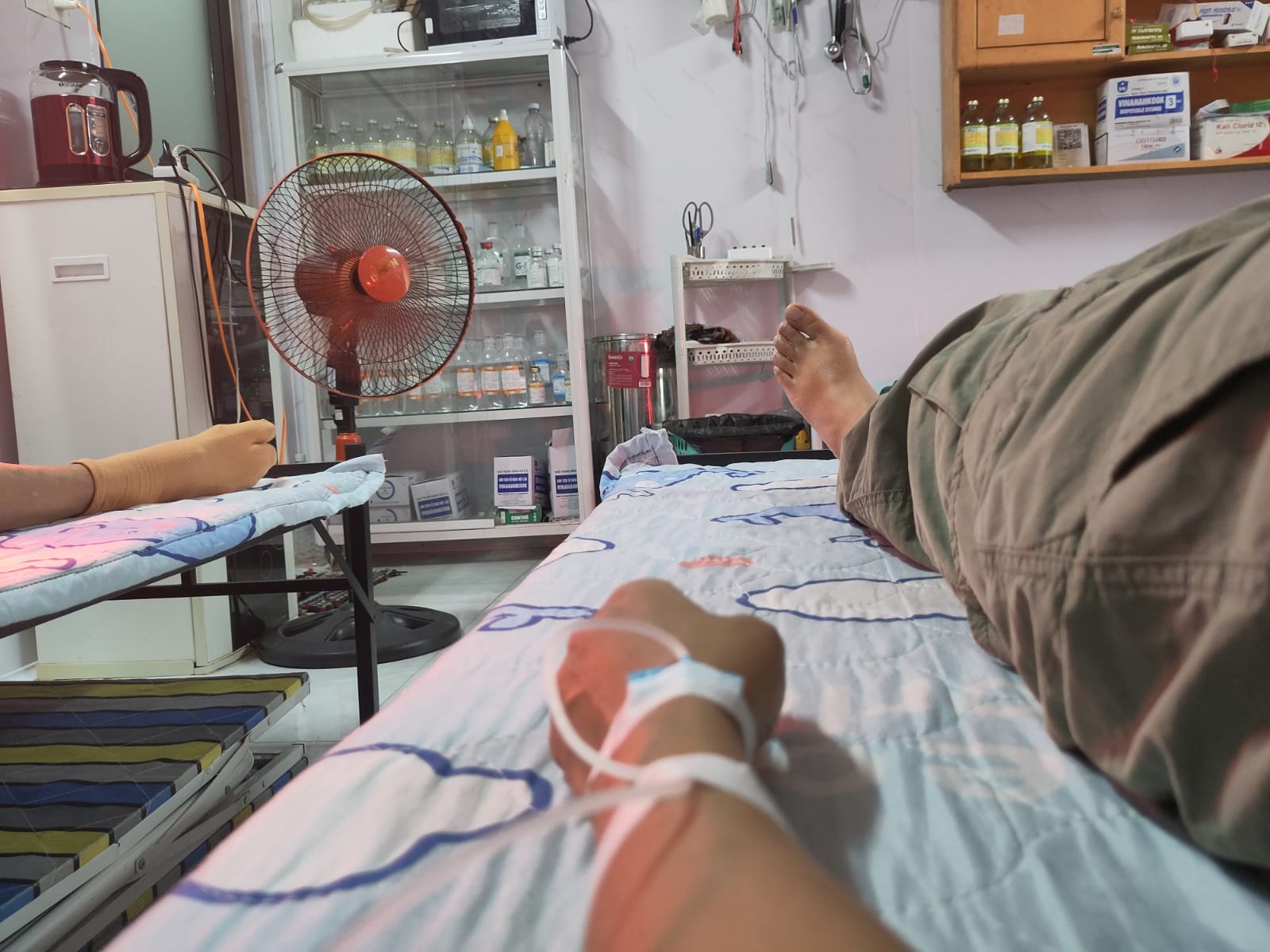
The other mother in our shared villa asked me later: What did they give you? Don’t you want to know what they put into your body?
In the moment, I shrugged. And I sat with that question for a long time.
Part of me didn’t want to know. Not because I was careless, but because I had already made the decision to go, already chosen to trust, and in that state of exhaustion and fog, holding the question felt like one more thing to carry. I had asked for help. Help arrived. I let it in.
But her question stayed.
Because I am someone who is curious. Who usually wants to know. So what happened to that part of me in that room?
I think she went quiet so the rest of me could rest.
The morning after, I woke up with a little more energy. Not well, but more present. Curious again, which felt like its own kind of returning.
I know what vitality feels like. I have lived it.
There was a period in London when I danced on stilettos, twice a week, for a few years. By the end of each three hour session, something strange and wonderful would happen — I would feel more energized than when I arrived. As if the movement had opened a door and something larger had rushed in. I was buzzing. Euphoric. My body became one with my dance partner. With the music. Completely myself.
Then there was the season of building Impact Hub Basel — stolen breakfasts, late nights, borrowed lunch hours — all while holding down a full-time corporate job. I had so little time, and yet I got so much done. Every conversation, every meeting, every scribbled note felt like it was feeding me rather than costing me. I was expanding from within. Radiating. It felt like a river, always in motion, always replenishing itself.
That is what vitality means to me. Not the absence of tiredness. Not a perfect morning routine. But that particular quality of fullness — where you are so aligned with what you are doing and who you are being that energy flows toward you, not just out of you.
Right now, I will be honest — I am not there.
I often feel like I am starting from empty rather than from full. The thing that lit me up the way dancing did, the way Impact Hub did — I haven’t found it yet in this season. Taiji Qigong calls to me, quietly and steadily, and I trust it is part of my path. But it is a slow river, and I am still learning to be patient with slow rivers.
What I long for is simple: to wake up naturally and rested. To feel grounded before the day asks anything of me. To find the thing — or let the thing find me — that makes the river run again. To move from a place of abundance rather than from the edge of depletion.
This illness, I think, is part of that reckoning. A reminder that I cannot build from empty. That vitality is not a reward for doing everything right. It is the condition that makes everything else possible.
And so I am asking myself the questions. Honestly, without any ready answers.
What is my body trying to tell me? The stress I think I’m handling — am I really? The emotions I believe I’ve processed — have I? Am I finally willing to listen?
The body is not separate from life. It is the foundation of it.
And now, over to you. I would love to know…
What does vitality mean to you? Not the definition, but the feeling of it. And when it dips — what does your body ask of you?
Maybe you already know the answer. Maybe, like me, you’re still learning to hear it.
May you always have vitality in your life.
May you always be in flow.
With love and joy,
Connie 💛
Subscribe to The Flow Journey
If something in this letter stayed with you — the heat rising in the throat as a quiet warning, the moment of putting the phone down and finally resting, the question of what your body might be asking that you haven’t quite stopped to hear — The Flow Journey is where I explore these things each week. An honest, ongoing inquiry into what it means to live fully, care for the people we love, and build a life with vitality at its foundation, wherever in the world you happen to be.
You are warmly welcome, in whatever way feels right — free or paid.
New here? You can explore past reflections from The Flow Journey here →
Sharing the Journey
The Flow Journey publishes every Sunday. If this letter found you at the right moment — if you too know what it is like to keep steering the ship even when you’re running on empty — consider passing it on to someone who might need permission to rest.